April 14, 2026 / Grade: C
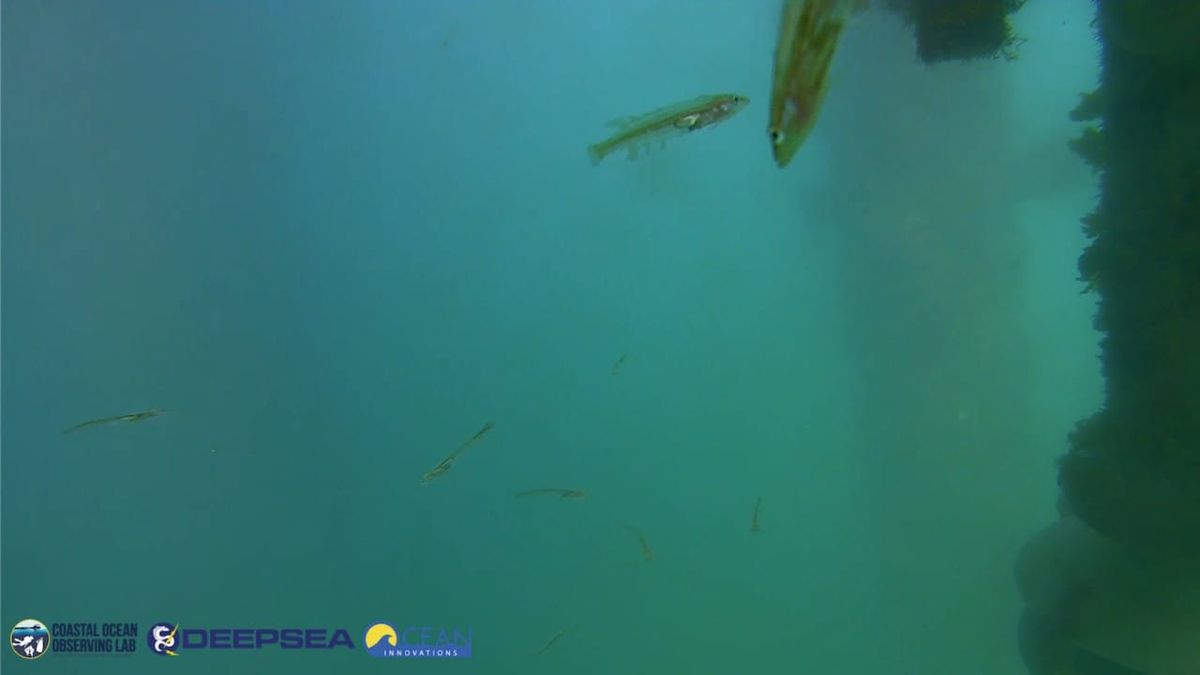
3:00 PM Update — Grade C
Visibility: 10–13 ft
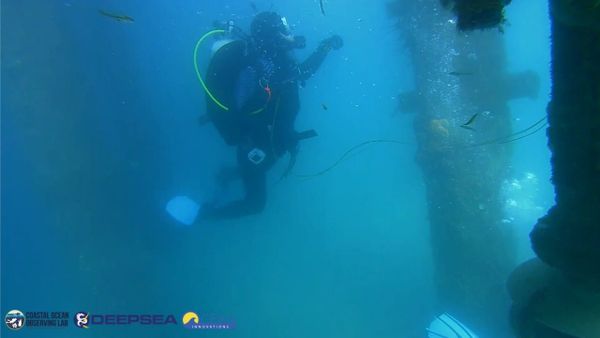
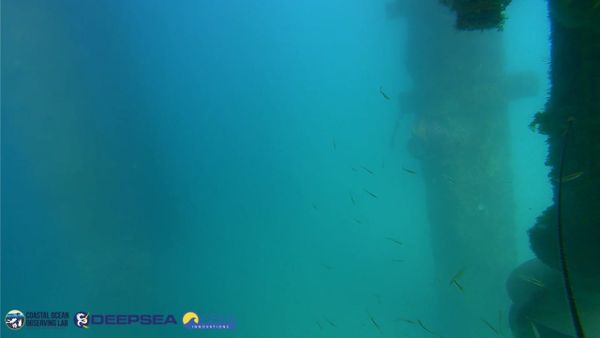
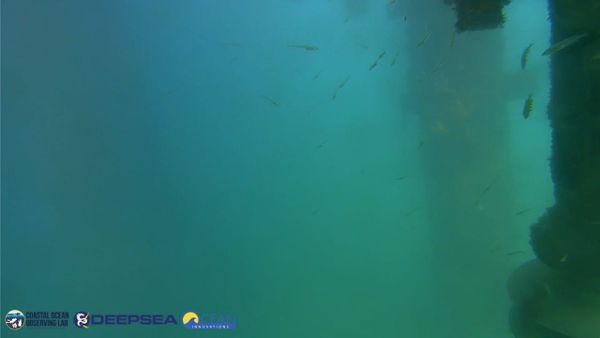
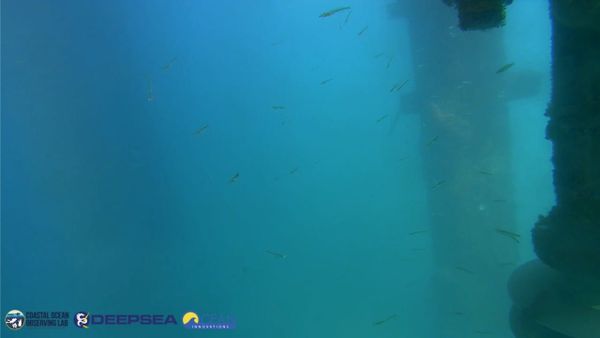
The 4 ft pilings on the right side of the frame are visible but appear somewhat soft and greenish, lacking sharp surface detail — acceptable but not crisp. The 11 ft pilings are faintly discernible as elongated shadowy forms in the mid-frame area, with very little structural definition, indicating significant haze at that distance. The 14 ft piling set cannot be independently identified as a third distinct tier — only two piling tiers are detectable, and the counting rule therefore caps this at C or lower. The water is a murky green-teal color with moderate particulate scatter, reducing contrast throughout the water column. Several small fish (likely topsmelt or similar pelagic species) are visible near the surface, suggesting the camera is looking upward at a shallow angle. Overall clarity is moderate-to-poor with a noticeable green haze dominating the mid and far ranges.
The green tint and suspended particulate matter suggest elevated biological productivity or mild phytoplankton presence, which is common in nearshore La Jolla waters during periods of upwelling or nutrient mixing. Short-period swell and modest wind chop likely contributed to some sediment and organic material being stirred into suspension near the pier. Visibility appears to be limited primarily by biological turbidity rather than extreme sediment resuspension.
Conditions are marginal for diving with visibility estimated around 10–13 ft — acceptable for experienced local divers but not ideal for photography or newer divers. Conditions may improve slightly around the incoming low tide cycle if wave energy settles, but no dramatic improvement is expected today without a significant change in offshore conditions.
• Wind: 10.7 mph
• Cloud Cover: 2%
• Water Temp: 67.8°F
• Chlorophyll: 0.37 mg/m³ (GREEN)
• Swell: 2.3 ft @ 7.0 sec from NW (282°) — favorable
• Tide: Unknown → next L at 01:45 (0.919 ft)
• Community Report: No report
12:00 PM Update — Grade C
Visibility: 10–13 ft
The 4 ft pilings on the right side of the frame are visible but appear somewhat soft, with limited surface detail — kelp and barnacle texture is faintly discernible but not crisp. The 11 ft pilings are present but hazy, visible as elongated vertical forms without clear structural definition, suggesting moderate turbidity at that range. The 14 ft piling set cannot be independently confirmed as a third distinct tier — only two piling sets are reliably identifiable, and per the counting rule this places the grade at C or lower. The water has a characteristic blue-green tint with noticeable particulate haze suspended throughout the water column. Scattered small fish are visible in the mid-water, which is consistent with moderate but not poor visibility. Overall, the scene reads as moderately turbid with acceptable but not good conditions — structural detail degrades quickly with distance.
The blue-green water color and suspended particulate haze suggest a moderate plankton or sediment load in the water column, which is common during rising tide cycles that can stir nearshore particulates. The greenish tint toward the lower frame hints at mild biological turbidity rather than heavy sediment, possibly a light phytoplankton presence. Short-period swell from the northwest would contribute to bottom agitation and resuspension of fine material near the pier structure.
Conditions are marginal — acceptable for experienced divers but visibility is limited enough to reduce enjoyment of detailed reef or kelp work. The rising tide may further reduce clarity through the afternoon; an early morning window on the outgoing tide would likely offer better conditions.
• Wind: 9.6 mph
• Cloud Cover: 5%
• Water Temp: 68.0°F
• Chlorophyll: 0.37 mg/m³ (GREEN)
• Swell: 2.3 ft @ 7.0 sec from NW (277°) — favorable
• Tide: Rising → next H at 20:15 (4.816 ft)
• Community Report: No report
Visibility is currently around 10–13 ft, based on the latest Scripps Pier camera image.
The 4 ft pilings on the right side of the frame are visible but show soft edges and reduced surface detail, suggesting moderate haze even at close range. The 11 ft pilings are present but appear as indistinct, low-contrast shapes without clear structural definition — surface texture is largely lost to scattering. The 14 ft pilings cannot be confidently identified as a third distinct tier beyond the 11 ft set; what appears in the mid-to-far field are scattered small fish silhouettes and diffuse haze rather than a recognizable piling structure. Because only two piling tiers can be independently confirmed, the grade cannot exceed C per the counting rule. Water color is a characteristic teal-green with significant light scattering, consistent with moderate turbidity and possible phytoplankton or particulate suspension.
The teal-green water color and uniform haze throughout the water column suggest elevated particulate or biological turbidity rather than a sediment event. Light rays are visible entering from above, indicating decent surface light, but the water is scattering it broadly rather than transmitting it cleanly — typical of a plankton bloom or suspended fine particles. Rising tide conditions may be drawing offshore water through the pier zone and could be slowly shifting turbidity levels during this window.
Conditions are marginal for diving at roughly 10–13 ft visibility — adequate for experienced local divers but not ideal for photography or navigation-dependent dives. Visibility may improve slightly if tide stabilizes or with an early morning check before the next rising cycle brings additional water movement.
Current Conditions
• Wind: 2.4 mph
• Cloud Cover: 30%
• Water Temp: 67.1°F
• Chlorophyll: 0.37 mg/m³ (GREEN)
• Swell: 3.0 ft @ 7.0 sec from NW (288°) — favorable
• Tide: Rising → next H at 20:15 (4.816 ft)
• Community Report: No report
Dive Grade: C
🎥 Live Camera: https://coollab.ucsd.edu/pierviz/