April 11, 2026 / Grade: C
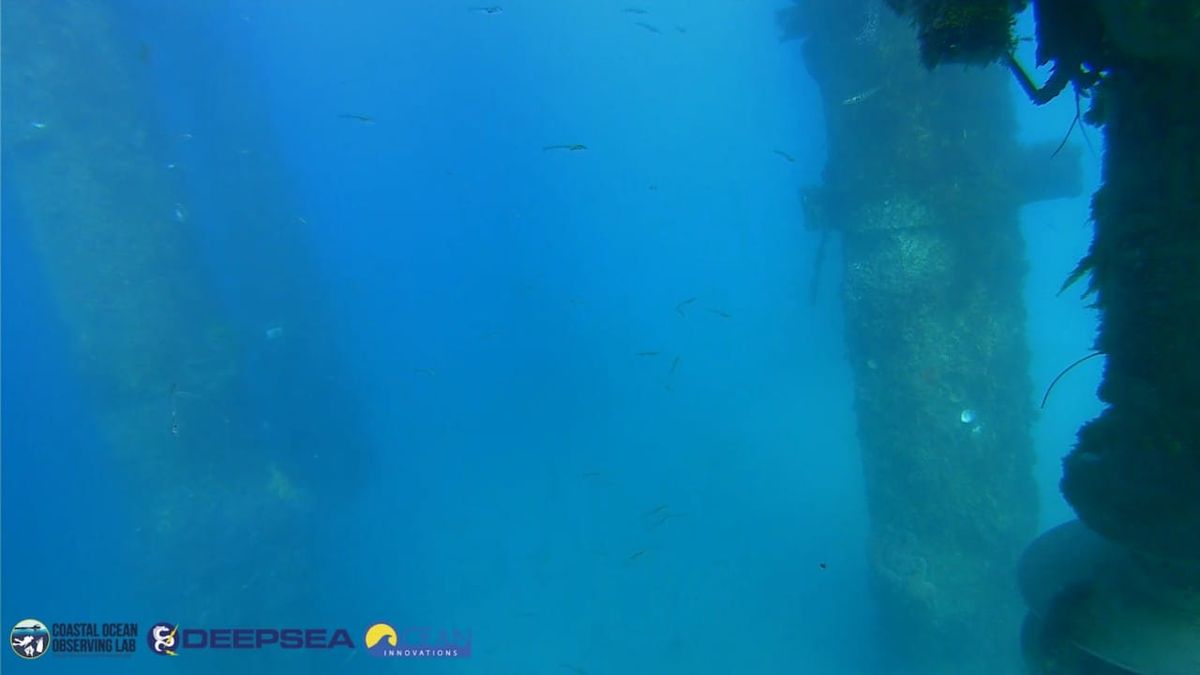
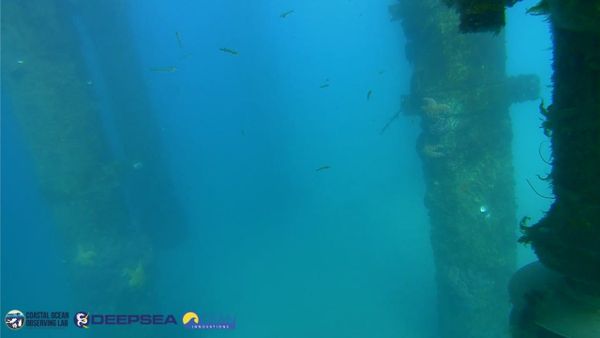
3:00 PM Update — Grade C
Visibility: 10–13 ft
The 4 ft pilings on the right side of the frame are visible with some surface detail and biofouling texture discernible, though they appear somewhat soft rather than crisp — acceptable for near distance. The 11 ft pilings are detectable as a hazier structural form to the left, but definition is reduced with noticeable blue-green haze beginning to obscure surface detail. The 14 ft pilings cannot be confidently identified as a third distinct tier — there is no clearly separate third piling set visible beyond the 11 ft range; what appears in the mid-to-far field is diffuse blue haze with scattered small fish but no distinguishable structural forms that would confirm a third tier. The water has a mid-blue to blue-green cast with moderate particulate scatter visible throughout the water column. Overall clarity is moderate at best, with visibility falling off noticeably beyond the 11 ft range.
The blue-green hue and moderate particulate scatter suggest a mix of suspended sediment and possible low-level plankton presence, which is common under these tidal and swell conditions. Long-period groundswell can stir bottom sediment and create surge-driven turbidity even when surface conditions appear calm. The scattered small fish visible in the water column are consistent with typical pier conditions but do not indicate exceptional clarity.
Conditions are marginal for diving — visibility is workable for casual pier diving but not ideal for photography or detailed observation beyond 10–13 ft. Conditions may improve slightly around the approaching low tide early in the morning as tidal exchange slows, but significant improvement is uncertain given the active swell.
• Wind: 10.7 mph
• Cloud Cover: 2%
• Water Temp: 68.7°F
• Chlorophyll: 0.37 mg/m³ (GREEN)
• Swell: 1.3 ft @ 17.0 sec from NW (289°) — favorable
• Tide: Unknown → next L at 00:26 (2.214 ft)
• Community Report: No report
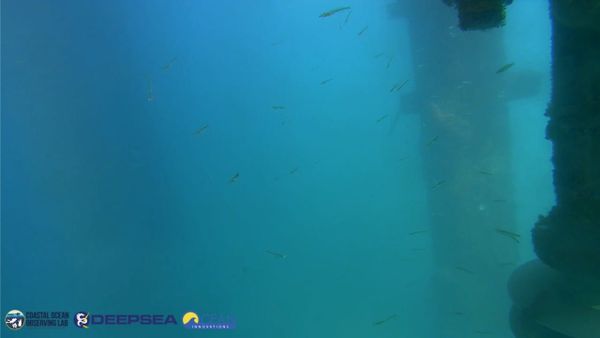
3:00 PM Update — Grade C
Visibility: 10–13 ft
The 4 ft pilings on the right side of the frame are visible with some surface detail — marine growth and barnacle texture is discernible, indicating reasonable near-field clarity. The 11 ft pilings are present but noticeably hazy, their structural detail softened significantly by particulate matter in the water column. The 14 ft piling set cannot be independently confirmed as a third distinct tier — only two piling sets are clearly identifiable, and any further structure dissolves into the blue-green haze beyond the 11 ft range. The water color is a milky turquoise-green rather than deep blue, indicating suspended particulates or mild plankton presence throughout the column. Needle-like fish (likely California grunion or topsmelt) are visible mid-water, suggesting reasonable but not excellent mid-range visibility. Overall, this is a moderate visibility day where the two-tier piling limit rules out Grade B under the counting protocol.
The milky blue-green water color suggests a mix of fine suspended sediment and possible light plankton bloom, which is common under these tidal and low-energy swell conditions. The relative calm at the surface may allow some settling of particles, but the persistent haze at mid-range distances indicates the water column is not clearing significantly. Low to moderate wind conditions are consistent with this level of particulate suspension rather than heavy wave-driven turbidity.
Conditions are marginal for recreational diving — acceptable for experienced divers comfortable with 10–13 ft visibility, but not ideal for photography or newer divers. If the long-period swell is flushing cleaner offshore water toward the pier, visibility may improve slightly around the incoming tide cycle, so checking again in a few hours could be worthwhile.
• Wind: 10.6 mph
• Cloud Cover: 3%
• Water Temp: 68.9°F
• Chlorophyll: 0.37 mg/m³ (GREEN)
• Swell: 1.3 ft @ 17.0 sec from NW (289°) — favorable
• Tide: Unknown → next H at 05:04 (3.915 ft)
• Community Report: No report
12:00 PM Update — Grade D
Visibility: 5–8 ft
The 4 ft pilings appear as soft, indistinct green-tinted masses with no discernible surface texture or structural detail — they are visible only as blurry organic shapes without crisp edges. The 11 ft pilings cannot be clearly identified as a distinct tier; there is a suggestion of darker mass in the mid-frame but no defined structure, contrast, or separation from the surrounding haze. The 14 ft pilings are entirely absent — only two vague tonal zones can be detected and neither qualifies as a clearly defined piling set. The water color is a murky green-brown with heavy particulate scatter, and a bright light source in the upper right (likely the surface or a lamp) is causing significant lens flare and bloom that further reduces usable contrast. Overall clarity is very poor — the image is dominated by diffuse green haze with no depth penetration evident beyond a few feet.
The heavy green tint and dense particulate scatter suggest elevated biological turbidity, likely a phytoplankton bloom or suspended organic material common in nearshore Southern California waters under these conditions. The murky green-brown coloration and lack of any blue-water clarity indicate poor water column transparency, possibly compounded by biological productivity stirred up by recent swell energy or tidal exchange. There is no evidence of clear blue water that would indicate favorable visibility conditions.
Conditions are not favorable for diving at this time — visibility is estimated at only 5–8 ft, which makes for a frustrating and potentially disorienting dive at Scripps. If the long-period swell subsides and tidal flushing improves water clarity, conditions may improve slightly in the early morning hours around the incoming high tide, but a significant improvement is not guaranteed given the apparent biological turbidity.
• Wind: 10.4 mph
• Cloud Cover: 20%
• Water Temp: 69.3°F
• Chlorophyll: 0.37 mg/m³ (GREEN)
• Swell: 1.3 ft @ 17.0 sec from NW (289°) — favorable
• Tide: Unknown → next H at 05:04 (3.915 ft)
• Community Report: No report
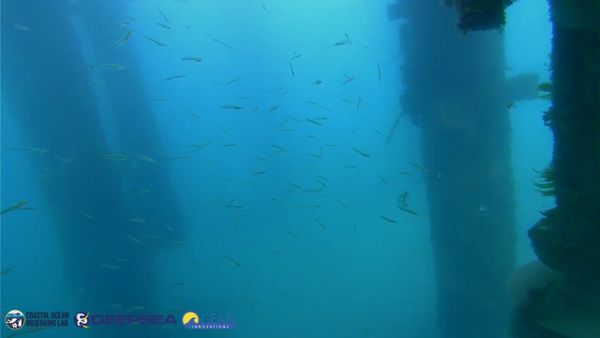
12:00 PM Update — Grade C
Visibility: 10–13 ft
The 4 ft pilings on the right side of the frame are visible but lack sharp surface detail, appearing somewhat soft with a mild haze even at close range. The 11 ft pilings are discernible as structural elements but are rendered hazy and lack crisp definition, with only general form rather than surface texture visible. The 14 ft piling set cannot be confidently identified as a distinct third tier — only two piling sets can be reliably located, meaning the 14 ft pilings are absent from view per the counting rule. The water is a characteristic murky teal-green rather than deep blue, indicating suspended particulate matter or plankton loading reducing optical clarity. The school of fish (likely Pacific sardines or similar forage fish) swimming mid-column is consistent with moderate-visibility greenish coastal water conditions. Overall the scene reflects classic Southern California moderate visibility with biological turbidity.
The green-teal water color strongly suggests elevated phytoplankton or suspended organic matter in the water column, which is a common coastal condition that scatters light and reduces horizontal visibility significantly. The relatively calm long-period swell present is unlikely to be causing heavy bottom sediment suspension, so the turbidity appears primarily biological in origin rather than wave-driven. This type of plankton-tinted water often persists for days and does not clear quickly with tidal changes alone.
Conditions are marginal for recreational diving with roughly 10–13 ft of visibility — acceptable for experienced local divers but not ideal for photography or novice divers. If visibility improvement is expected, an incoming high tide in the early morning hours may briefly flush cleaner water through, making a dawn dive worth considering.
• Wind: 10.4 mph
• Cloud Cover: 100%
• Water Temp: 68.9°F
• Chlorophyll: 0.37 mg/m³ (GREEN)
• Swell: 1.3 ft @ 17.0 sec from NW (289°) — favorable
• Tide: Unknown → next H at 05:04 (3.915 ft)
• Community Report: No report
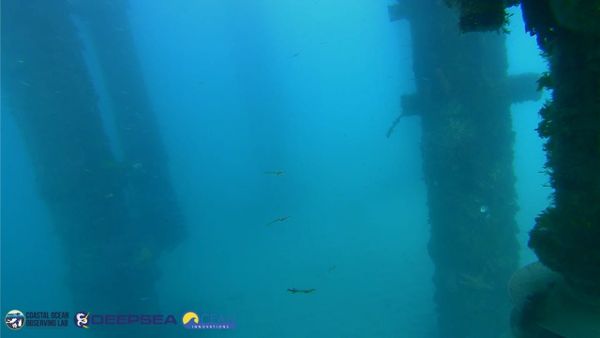
Visibility is currently around 10–13 ft, based on the latest Scripps Pier camera image.
The 4 ft pilings are visible on both sides of the frame but appear somewhat soft and lack sharp surface detail, suggesting mild haze even at close range. The 11 ft pilings are discernible in the mid-ground but are noticeably hazy and lack clear structural definition — they read more as dark shapes than textured surfaces. No convincing third piling set at 14 ft can be independently identified; what appears in the far background does not resolve into a distinct third tier with distinguishable structure. Only two piling tiers can be confidently located, which per the counting rule places this firmly at C or lower. The water is a milky blue-green with moderate particulate scatter visible throughout, consistent with suspended sediment or biological turbidity reducing contrast at distance.
The blue-green tint and diffuse light scatter suggest a mix of phytoplankton or fine suspended particulates in the water column, which is common during rising tide cycles that can resuspend nearshore material. The relatively uniform haze across the frame without strong green banding suggests moderate overall turbidity rather than a dense surface bloom. Long-period groundswell can cause gentle but persistent surge that keeps fine bottom sediment in suspension even without strong wind or breaking waves.
Conditions are marginal at roughly 10–13 ft visibility — adequate for recreational diving but not ideal for photography or detailed observation. Visibility may improve slightly after the tide peaks and begins to ebb, so checking again in the late afternoon or evening could reveal a better window if tidal stirring is the primary driver.
Current Conditions
• Wind: 5.3 mph
• Cloud Cover: 10%
• Water Temp: 67.6°F
• Chlorophyll: None mg/m³ (ERROR)
• Swell: 1.6 ft @ 17.0 sec from NW (291°) — favorable
• Tide: Rising → next H at 19:26 (3.523 ft)
• Community Report: No report
Dive Grade: C
🎥 Live Camera: https://coollab.ucsd.edu/pierviz/