April 2, 2026 / Grade: C
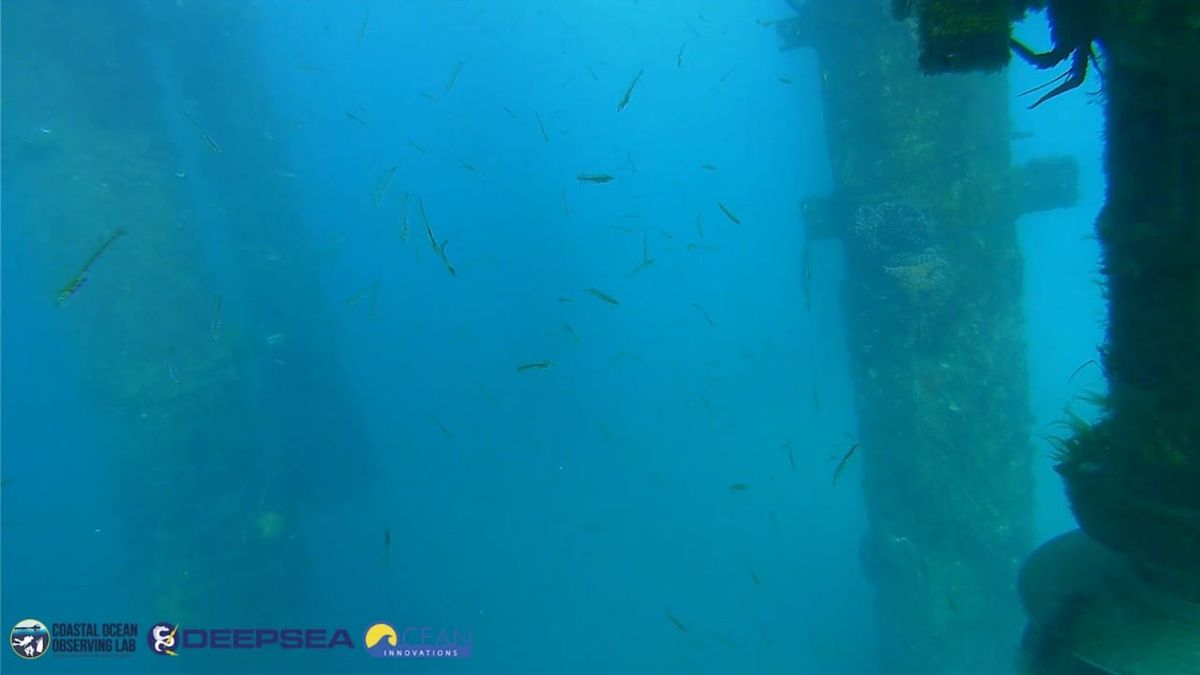
3:00 PM Update — Grade C
Visibility: 10–13 ft
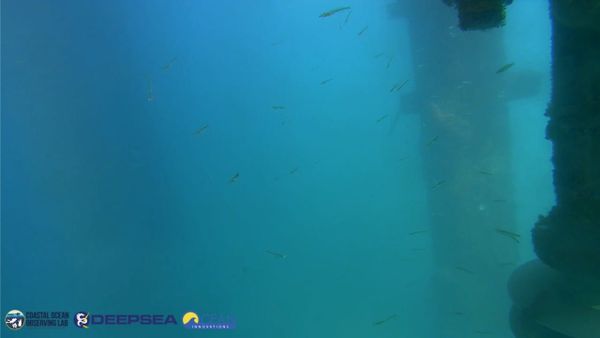
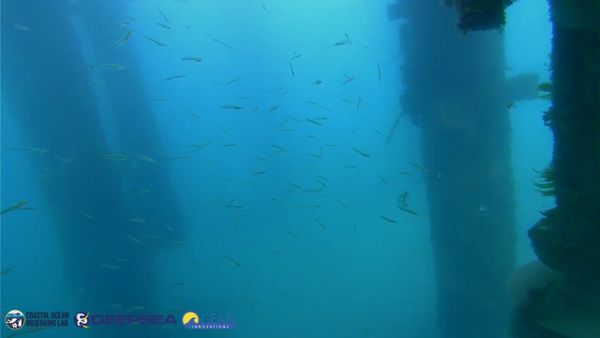
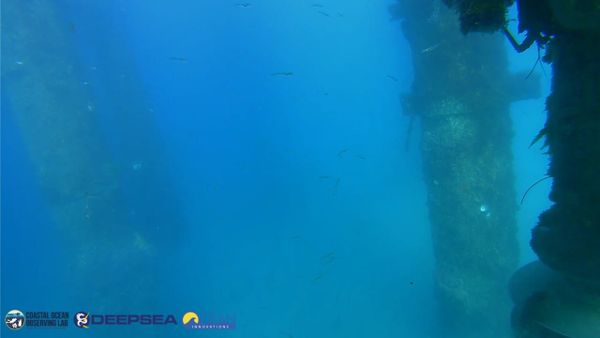
The 4 ft pilings on the right side of the frame are visible with some surface detail, including biological growth (kelp/algae), though they appear slightly softened by haze rather than razor-sharp. The 11 ft pilings are discernible as a second structural tier further into the frame, but they show moderate haze and reduced contrast — structure is present but not crisply defined. I cannot confidently identify a third distinct piling set at 14 ft; what appears beyond the 11 ft pilings dissolves into blue-green haze without clear structural definition. A school of small fish (likely anchovies or silversides) is visible mid-water, which helps gauge the light penetration — they are visible but background detail behind them is already fading. The water has a blue-green tint rather than deep blue, consistent with moderate turbidity. Overall, only two piling tiers are clearly identifiable, placing this firmly at Grade C per the counting rule. Clarity is marginal but adequate for basic orientation diving.
The blue-green water color and moderate haze suggest a mix of fine particulate suspension and possible light plankton bloom or sediment disturbance, both common at this site. Short-period swell conditions can generate bottom turbulence near the pier pilings, which may be contributing to the diffuse scatter visible throughout the water column. There is no severe greenish murk or brown tint, so conditions are moderate rather than poor.
Conditions are marginal for recreational diving — visibility is serviceable but not comfortable for detailed underwater work or photography. Conditions may improve slightly around the low tide cycle early morning when tidal flushing is favorable, so an early morning dive window could offer better clarity.
• Wind: 11.5 mph
• Cloud Cover: 75%
• Water Temp: 66.0°F
• Chlorophyll: 0.37 mg/m³ (GREEN)
• Swell: 2.3 ft @ 6.0 sec from NW (273°) — favorable
• Tide: Unknown → next L at 04:41 (-0.282 ft)
• Community Report: No report
3:00 PM Update — Grade C
Visibility: 10–13 ft
The 4 ft pilings on the right side of the frame are visible with some surface detail, showing biofouling texture and basic structural form, though they lack the crisp sharpness expected in good visibility. The 11 ft pilings are discernible as a second set further into the frame, but they appear notably hazy and lack clear structural definition — edges are soft and detail is lost to scattering. The 14 ft pilings cannot be confidently identified as a distinct third set; what lies beyond the 11 ft pilings fades into a uniform blue-green haze with no distinguishable piling structure, meaning only two tiers are reliably visible. The water color is a milky blue-green rather than a clear deep blue, indicating moderate particulate or plankton load throughout the water column. A loose school of elongated fish (likely topsmelt or similar) is visible mid-water, which is a normal biological indicator for these conditions. Overall clarity is reduced with significant light scattering, consistent with moderate visibility. Per the counting rule, with only two piling tiers clearly identifiable, this grades as C.
The milky blue-green water color and uniform haze throughout the water column suggest moderate turbidity, likely driven by a combination of short-period swell stirring up fine sediment near the bottom and possible plankton or particulate suspension in the upper water column. The diffuse, scattered light quality visible in the image is characteristic of conditions where visibility is limited by biological or sediment load rather than extreme surge. There is no strong green or brown tint indicating a severe plankton bloom, so conditions are moderate rather than poor.
Current conditions are marginal for recreational diving — functional but not rewarding, with visibility limiting situational awareness around the pilings. A better window may arrive near or after the overnight low tide as reduced tidal mixing and calmer early-morning conditions sometimes improve clarity, though the short-period swell will continue to keep some turbidity in the water column.
• Wind: 10.4 mph
• Cloud Cover: 75%
• Water Temp: 66.0°F
• Chlorophyll: 0.37 mg/m³ (GREEN)
• Swell: 2.3 ft @ 6.0 sec from NW (271°) — favorable
• Tide: Unknown → next L at 04:06 (-0.219 ft)
• Community Report: No report
12:00 PM Update — Grade C
Visibility: 10–13 ft
The 4 ft pilings on the right side of the frame are visible with moderate detail, showing some surface texture and what appears to be kelp or marine growth, though they are not sharply defined. The 11 ft pilings are discernible as darker vertical columns in the mid-frame but carry notable haze — structure is present but softened significantly by particulate scatter. The 14 ft pilings cannot be confidently identified as a distinct third tier; there are shadowy vertical suggestions in the far background but nothing that qualifies as clearly visible structure — this is at best a faint shadow and does not meet the threshold for Grade B. The water is a uniform blue-green hue rather than deep blue, indicating suspended particulates or plankton throughout the water column. The school of elongated baitfish (likely Pacific sardines or anchovies) is visible mid-water, which is a normal presence but also reflects moderate turbidity typical of C-range conditions. Overall, two piling tiers can be confidently identified; the third remains ambiguous at best.
The blue-green water color and diffuse light scatter suggest moderate turbidity, likely from a combination of suspended fine sediment stirred by short-period swell and possible phytoplankton bloom tint. Short-period chop tends to keep sediment in suspension near the surface and mid-column, which is consistent with the uniform haze visible throughout the frame. Rising tide conditions may be contributing additional turbid water from nearshore mixing, further limiting horizontal visibility.
Conditions are marginal for recreational diving — adequate for experienced divers comfortable with 10–13 ft visibility but not ideal for photography or less experienced divers. Visibility may improve slightly during slack water before the incoming tide peaks this evening, but conditions are unlikely to dramatically change today given the active swell and rising tide pattern.
• Wind: 10.4 mph
• Cloud Cover: 40%
• Water Temp: 65.8°F
• Chlorophyll: 0.37 mg/m³ (GREEN)
• Swell: 2.6 ft @ 5.0 sec from NW (277°) — favorable
• Tide: Rising → next H at 22:04 (5.27 ft)
• Community Report: No report
Visibility is currently around 15–20 ft, based on the latest Scripps Pier camera image.
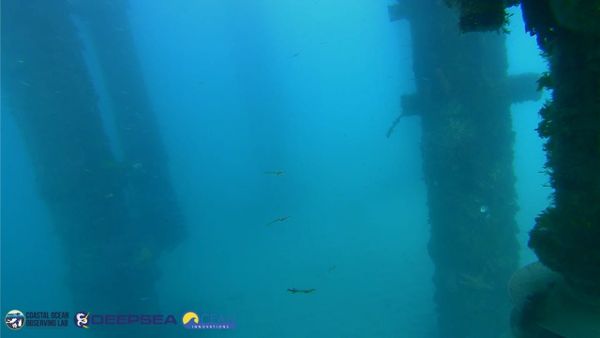
The 4 ft pilings are clearly visible with moderate surface detail, showing concrete texture and some biofouling growth — they are reasonably sharp though not perfectly crisp. The 11 ft pilings are identifiable as a distinct second tier with discernible structure, though some haze softens their edges and reduces fine detail. A third set of pilings is visible in the background beyond the 11 ft tier, which I am identifying as the 14 ft pilings — they are present and hazy but retain enough structural shape to be distinguishable as a separate tier rather than mere shadows. The water color is a clear blue-teal, which is a positive indicator, with good light penetration from the surface visible in the upper frame. The school of elongated fish (likely Pacific sand lance or similar forage fish) swimming freely through the mid-water column further suggests reasonable water clarity. Overall, three distinct piling tiers are identifiable, supporting a Grade B assessment, though the haziness of the far tier keeps this in the lower-B range.
The blue-teal water color suggests relatively low particulate or plankton load, which is consistent with moderate-to-good visibility conditions. Some diffuse haze in the mid-to-far field likely reflects a mild suspension of fine particles or light plankton bloom rather than heavy turbidity or sediment. The rising tide noted in sensor data may be introducing some mixing that slightly softens the far-field clarity.
Conditions are currently decent for a dive, with three piling tiers visible and blue water — this is an acceptable window. Visibility may decline somewhat as the tide continues to rise toward its evening high, so diving sooner rather than later today would be advisable.
Current Conditions
• Wind: 9.2 mph
• Cloud Cover: 100%
• Water Temp: 65.8°F
• Chlorophyll: 0.37 mg/m³ (GREEN)
• Swell: 2.0 ft @ 4.0 sec from NW (282°) — favorable
• Tide: Rising → next H at 22:04 (5.27 ft)
• Community Report: No report
Dive Grade: B
🎥 Live Camera: https://coollab.ucsd.edu/pierviz/