April 5, 2026 / Grade: C
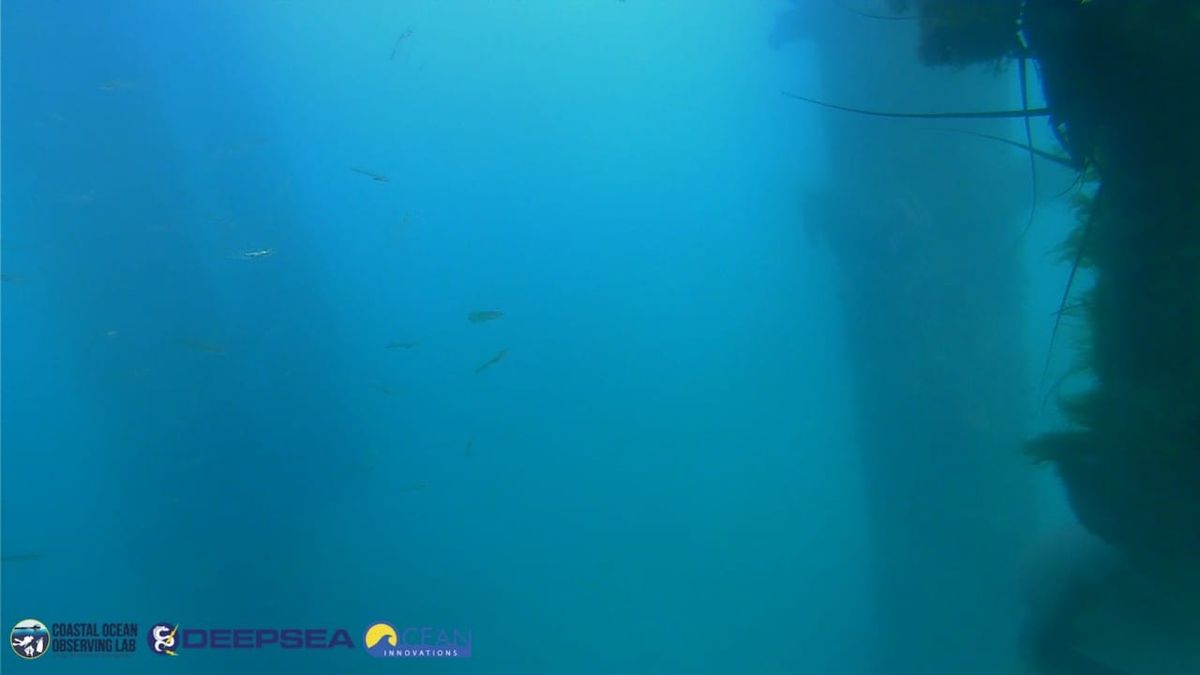
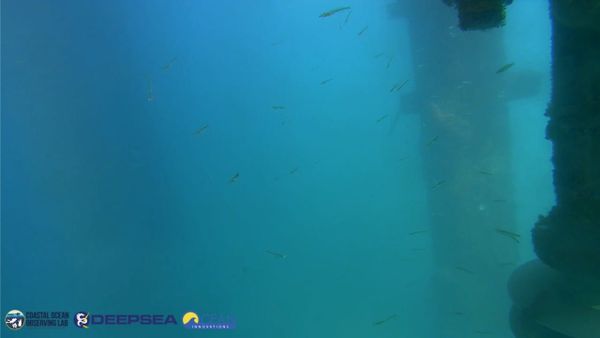
3:00 PM Update — Grade C
Visibility: 10–13 ft
The 4 ft pilings on the right side of the frame are visible with some structural detail — the kelp and pipe structures attached to them are discernible, indicating reasonable near-field clarity. The 11 ft pilings are present but noticeably hazy, with outlines visible but surface texture and fine detail largely lost to scattering. The 14 ft pilings cannot be confidently identified as a distinct third tier — there is no clear third set of structural forms beyond the mid-range pilings, only diffuse blue haze. Water color is a medium cyan-blue with moderate particulate scattering throughout the water column. Several small fish are visible in the mid-water, which helps confirm mid-range visibility is passable but not strong. The overall scene lacks the deep blue transparency of Grade B conditions. Following the counting rule, only two piling tiers are clearly identifiable, placing this firmly at Grade C.
The moderate cyan-blue tint with uniform scattering throughout the water column suggests a mix of fine particulate matter and possibly mild plankton content typical of coastal upwelling or post-swell sediment disturbance. The visibility is consistent with conditions where water has had some time to settle but has not fully cleared. No strong green tint or severe turbidity is present, suggesting conditions are mid-range rather than actively deteriorating.
Conditions are marginal for diving — adequate for experienced divers familiar with the site but not ideal for photography or low-visibility-sensitive activities. With a low tide approaching in the early morning and relatively modest swell, visibility may improve slightly overnight into early morning if there is no new disturbance.
• Wind: 9.0 mph
• Cloud Cover: 75%
• Water Temp: 66.6°F
• Chlorophyll: None mg/m³ (ERROR)
• Swell: 1.3 ft @ 10.0 sec from NW (278°) — favorable
• Tide: Unknown → next L at 06:43 (0.215 ft)
• Community Report: No report
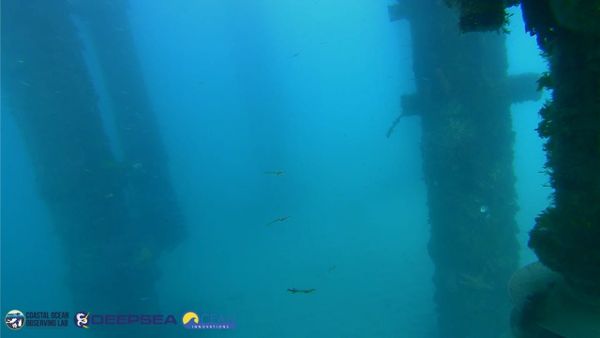
3:00 PM Update — Grade C
Visibility: 10–13 ft
The 4 ft pilings on the right side of the frame are visible but appear as dark silhouettes with limited surface detail, suggesting some haze even at close range. The 11 ft pilings are present but notably hazy and indistinct, lacking clear structural definition — they appear as soft, blurred shapes in the mid-water column. The 14 ft piling set cannot be confidently identified as a distinct third tier; there are no clearly resolved structures beyond the 11 ft range that would confirm a third set. The water is a fairly uniform mid-blue with moderate particulate scatter visible throughout, and a school of small fish in the mid-frame highlights the suspended material reducing clarity. Overall, the image shows two identifiable piling tiers at best, placing this firmly at Grade C per the counting rule.
The water shows moderate turbidity with a clean blue tone rather than green, suggesting suspended particulates or plankton rather than heavy sediment stirring. The rising tide may be pushing in water with elevated particulate load, which is consistent with the softened mid-range visibility observed. Conditions appear typical of moderate coastal upwelling or tidal exchange rather than storm-related turbidity.
Current visibility is marginal for recreational diving — adequate for experienced divers familiar with the site but not ideal for photography or low-experience divers. Conditions may improve slightly around low tide or in the early morning before tidal exchange increases, so checking again post-midnight or early tomorrow morning could yield a better window.
• Wind: 10.4 mph
• Cloud Cover: 40%
• Water Temp: 66.7°F
• Chlorophyll: 0.37 mg/m³ (GREEN)
• Swell: 1.0 ft @ 10.0 sec from NW (281°) — favorable
• Tide: Rising → next H at 23:14 (4.889 ft)
• Community Report: No report
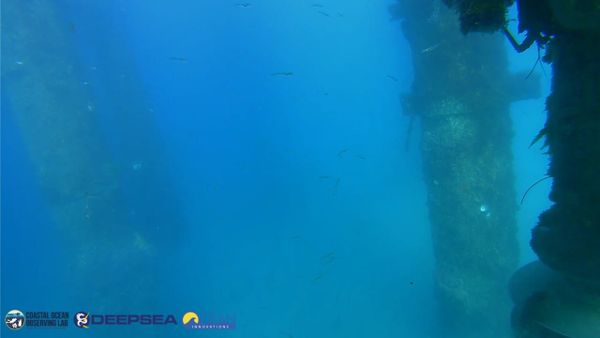
12:00 PM Update — Grade C
Visibility: 10–13 ft
The 4 ft pilings on the right side of the frame are visible with moderate surface detail, showing algae growth and some structural texture, though not razor-sharp. The 11 ft pilings are discernible in the mid-frame but carry noticeable haze and reduced contrast, with structure visible but softened. The 14 ft pilings cannot be independently confirmed as a third distinct tier — only two piling sets can be reliably identified, which per the counting rule places this firmly at C or lower. The water has a greenish-teal cast rather than deep blue, consistent with moderate turbidity and possible plankton or particulate suspension. A loose school of small elongated fish (likely anchovies or similar forage fish) is scattered throughout the mid-water column, suggesting active biological activity. Overall clarity is moderate with significant light scattering reducing depth penetration.
The greenish teal water color strongly suggests elevated particulate matter or phytoplankton in the water column, which is scattering light and reducing horizontal visibility. The rising tide may be drawing in less clear oceanic water or resuspending nearshore sediment, contributing to the moderate turbidity observed. Biological activity indicated by the dense fish school also points to nutrient-rich, somewhat turbid nearshore water conditions.
Conditions are marginal for recreational diving with roughly 10–13 ft of visibility — adequate for shallow reef work close to the pilings but not ideal for photography or extended exploration. Visibility may improve slightly later if the tide peaks and stabilizes, though divers should reassess conditions at the water's edge before committing.
• Wind: 11.5 mph
• Cloud Cover: 40%
• Water Temp: 67.6°F
• Chlorophyll: 0.37 mg/m³ (GREEN)
• Swell: 1.3 ft @ 11.0 sec from NW (289°) — favorable
• Tide: Rising → next H at 23:14 (4.889 ft)
• Community Report: No report
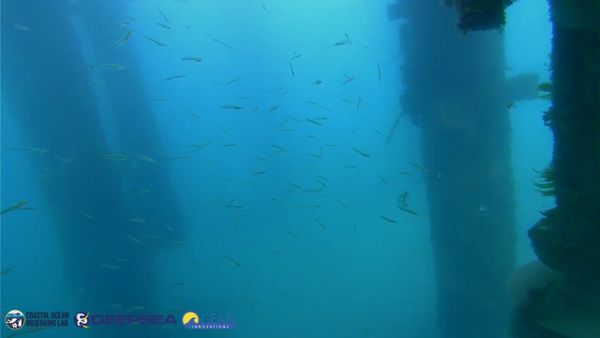
12:00 PM Update — Grade B
Visibility: 15–20 ft
The 4 ft pilings on the right side of the frame are clearly visible with reasonable surface detail and structural definition, appearing sharp against the blue water. The 11 ft pilings are visible as a second distinct set, showing some haze but with structure still discernible — cross-bracing and piling edges are identifiable. A third set of pilings that would correspond to the 14 ft range appears to be faintly but genuinely present deeper in the frame, visible as hazy but structured forms rather than mere shadows, though they are at the threshold of clear identification. The water is a deep, clean blue with no green tint, suggesting good overall water quality and relatively low particulate load. There is a loose school of elongated fish — likely barracuda or needlefish — distributed throughout the mid-water column, which is consistent with clear, open pelagic conditions. The overall scene suggests moderate-to-good visibility with the deeper tier just barely qualifying as discernible with structure. Given the borderline nature of the 14 ft tier visibility, this is conservatively graded as lower-B.
The deep blue water color indicates clean oceanic water with minimal terrestrial runoff or phytoplankton bloom influence, which is characteristic of good late-season or offshore-influenced conditions at Scripps. The mild haze at distance is consistent with a modest amount of suspended particulates or micro-plankton rather than sediment turbidity. A rising tide can introduce some mixing and particulate suspension, which may explain the slight reduction in clarity at the farther piling tiers.
Conditions are acceptable for diving now with moderate-to-good visibility in the 15–20 ft range and clean blue water. Visibility may decrease slightly as the tide continues to rise toward its evening high, so diving earlier in the current tidal cycle would likely offer marginally better conditions.
• Wind: 9.0 mph
• Cloud Cover: 0%
• Water Temp: 68.2°F
• Chlorophyll: 0.37 mg/m³ (GREEN)
• Swell: 1.3 ft @ 10.0 sec from NW (284°) — favorable
• Tide: Rising → next H at 23:14 (4.889 ft)
• Community Report: No report
12:00 PM Update — Grade D
Visibility: 5–8 ft
The image is heavily blurred and dominated by murky green-teal water with significant backscatter, suggesting high particulate matter or plankton density in the water column. The 4 ft pilings are not clearly identifiable as distinct structures with surface detail — the bright white overexposed blob in the lower right appears to be the nearest piling set caught in the camera light, but it is blown out and lacks any visible surface texture or structural definition. The 11 ft pilings are not discernible as a clearly defined set; the greenish haze and scattering of light prevent any coherent structure from being seen at mid-range. The 14 ft pilings are entirely absent from view — there is no third piling tier detectable at any level of confidence. The water exhibits a characteristic murky green color with heavy light scattering, consistent with poor visibility conditions well below 10 feet.
The deep green, highly turbid water color with intense backscatter suggests elevated biological particulates — likely a plankton bloom or resuspended sediment — reducing light penetration and horizontal visibility dramatically. The teal-green hue is characteristic of phytoplankton-laden coastal water rather than clear blue oceanic water, pointing to biologically driven turbidity. A rising tide may be further introducing turbid nearshore water across the camera's field of view.
Conditions are poor and not recommended for diving at this time, with visibility likely in the 5–8 ft range. Divers should monitor the camera later in the day or around or after the tidal cycle turns to ebbing, as outgoing tides sometimes allow clearer offshore water to move in, though improvement is not guaranteed given the apparent biological turbidity.
• Wind: 6.0 mph
• Cloud Cover: 40%
• Water Temp: 65.7°F
• Chlorophyll: 0.37 mg/m³ (GREEN)
• Swell: 1.3 ft @ 11.0 sec from NW (282°) — favorable
• Tide: Rising → next H at 23:14 (4.889 ft)
• Community Report: No report
Visibility is currently around 10–13 ft, based on the latest Scripps Pier camera image.
The 4 ft pilings on the right side of the frame are visible with some surface texture discernible, though they appear moderately softened rather than crisp and sharp. The 11 ft pilings are identifiable as structural forms in the mid-range but carry noticeable haze — their surfaces lack clear definition and they blend into the blue-green water column. The 14 ft pilings cannot be confidently identified as a distinct third set; what appears in the far background is ambiguous and could be light scattering or very faint structural hints rather than a clearly defined piling tier. The water has a medium blue-teal tone with moderate particulate haze throughout the water column, reducing contrast at all distances. Fish are visible scattered through the frame, which is consistent with moderate visibility conditions where the water is not entirely opaque. Overall, only two piling tiers can be confidently identified, which per the counting rule places this firmly at C or lower.
The water has a blue-teal hue with diffuse particulate haze suggesting moderate suspended sediment or biological particulate load, possibly a light plankton bloom contributing to the milky quality of the mid and far water column. The falling tide may be beginning to flush some cleaner oceanic water through, but conditions have not yet cleared to Grade B threshold. The relatively calm swell and no wind suggest wave-driven turbidity is not the primary cause — this appears to be a background particulate or plankton-driven visibility limitation.
Conditions are marginal for recreational diving but acceptable for experienced divers comfortable with 10–13 ft visibility. The falling tide toward the afternoon low may improve conditions modestly over the next few hours, making a late afternoon dive worth considering if clarity is needed.
Current Conditions
• Wind: 0 mph
• Cloud Cover: 0%
• Water Temp: 65.3°F
• Chlorophyll: 0.37 mg/m³ (GREEN)
• Swell: 1.3 ft @ 11.0 sec from NW (285°) — favorable
• Tide: Falling → next L at 16:45 (1.819 ft)
• Community Report: No report
Dive Grade: C
🎥 Live Camera: https://coollab.ucsd.edu/pierviz/