March 25, 2026 / Grade: C
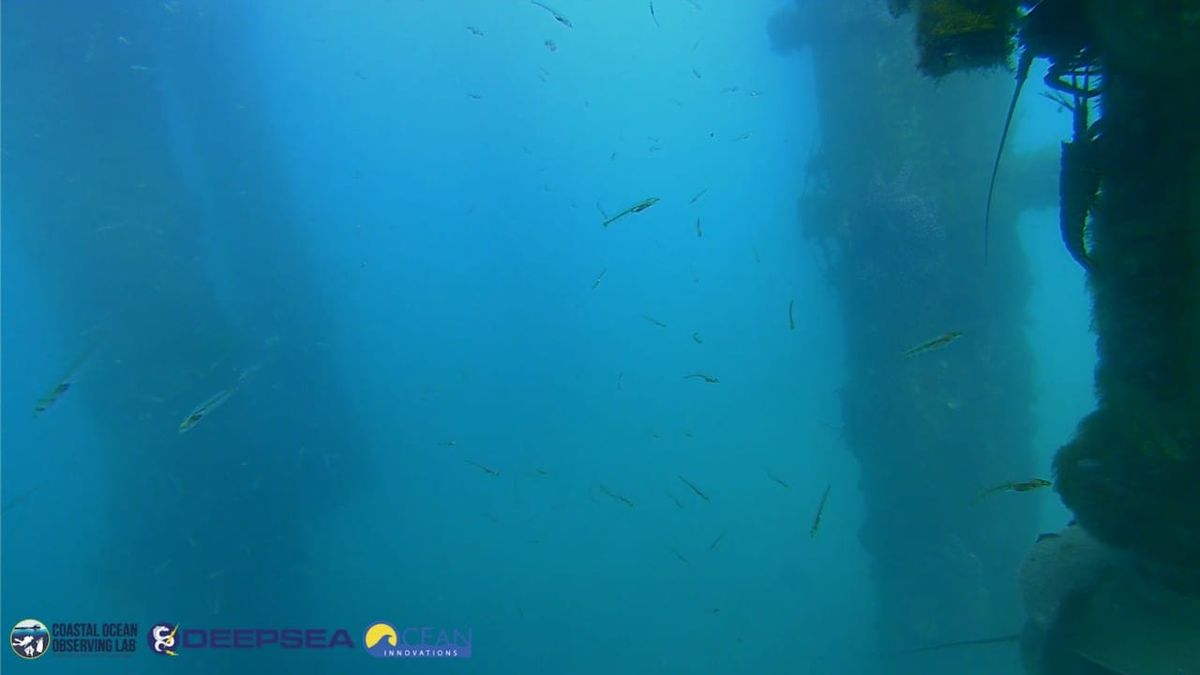
3:00 PM Update — Grade C
Visibility: 10–13 ft
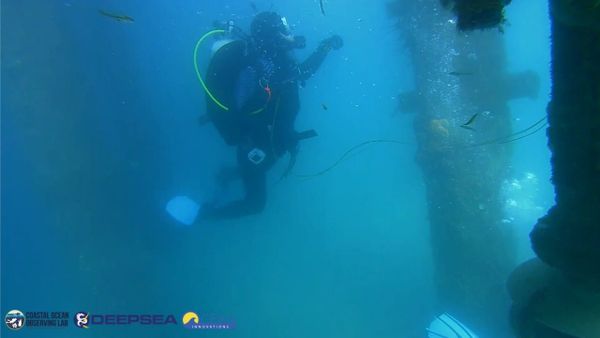
The 4 ft pilings on the right side of the frame are visible with some structural detail, including barnacle/algae encrustation, though they appear slightly softened by haze rather than razor sharp. The 11 ft pilings are identifiable as mid-distance structures but carry noticeable haze and reduced contrast, with structural detail present but not crisp. I can identify what appears to be only two distinct piling tiers with confidence — a potential third set at 14 ft is not clearly distinguishable as a separate, structured tier beyond the mid-range pilings; any shapes at that distance are too faint and indistinct to qualify as clearly present. The water is a medium blue-green with a uniform suspended particle haze throughout the water column, consistent with moderate turbidity. Per the counting rule, I cannot confirm three independent piling tiers, placing this firmly at Grade C.
The blue-green hue and relatively uniform haze throughout the water column suggest a mix of fine suspended particulates and possibly mild biological turbidity such as phytoplankton or organic matter in suspension. The long-period groundswell, even at low height, is likely generating gentle surge that keeps fine sediment gently disturbed near the bottom. Visibility appears limited primarily by suspended particulates rather than severe biological bloom, suggesting conditions are moderate rather than actively deteriorating.
Conditions are marginal for diving — acceptable for experienced divers familiar with the site but not ideal for photography or low-visibility-sensitive activities. If swell remains calm and tidal flushing improves water exchange over the next few hours, a modest improvement is possible, but conditions are unlikely to exceed Grade C today without a significant change in water clarity.
• Wind: 7.2 mph
• Cloud Cover: 36%
• Water Temp: 68.7°F
• Chlorophyll: 0.37 mg/m³ (GREEN)
• Swell: 1.0 ft @ 17.0 sec from NW (296°) — favorable
• Tide: Unknown → next H at 03:49 (4.67 ft)
• Community Report: No report
3:00 PM Update — Grade C
Visibility: 10–13 ft
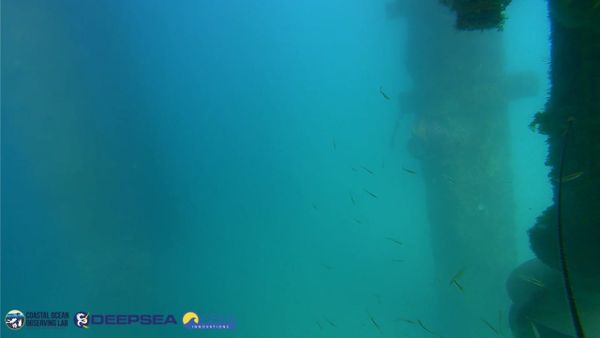
The 4 ft pilings on the right side of the frame are visible with some surface detail, including what appears to be marine growth, though clarity is somewhat reduced. The 11 ft pilings are discernible as darker vertical forms but show notable haze and lack crisp structural definition. The 14 ft pilings cannot be independently confirmed as a distinct third tier — there may be a faint shadowy suggestion of structure in the far distance, but it does not meet the threshold of clearly present and hazy with discernible structure. The water is a mid-toned blue-green, not the deep vivid blue characteristic of high-visibility conditions. Numerous small elongated fish (likely silversides or similar species) are scattered throughout the water column, indicating moderate planktonic or particulate suspension. Overall, the scene conveys moderate visibility with meaningful haze beginning well before the mid-range pilings.
The blue-green cast and suspended particulates visible throughout the water column suggest moderate turbidity, possibly from mild surge stirring fine sediment off the seafloor. The presence of abundant small schooling fish is consistent with elevated plankton or particulate levels that scatter light and reduce horizontal visibility. These conditions are typical of transitional or mixed-water periods at this site.
Conditions are marginal for recreational diving — visibility is functional but not ideal, particularly for photography or detailed observation. Conditions may improve slightly during slack tide or if surge decreases, so checking again later in the day or early morning could yield a better window.
• Wind: 10.4 mph
• Cloud Cover: 0%
• Water Temp: 68.7°F
• Chlorophyll: 0.37 mg/m³ (GREEN)
• Swell: 1.0 ft @ 15.0 sec from NW (291°) — favorable
• Tide: Unknown → next H at 02:07 (4.858 ft)
• Community Report: No report
12:00 PM Update — Grade C
Visibility: 10–13 ft
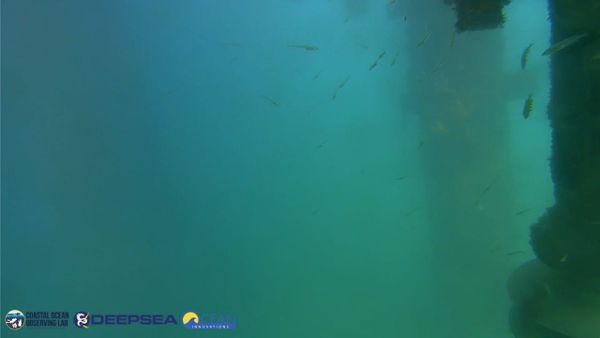
The 4 ft pilings on the right side of the frame are visible but show only moderate surface detail — the concrete texture is somewhat discernible but softened by haze, suggesting conditions are not pristine. The 11 ft pilings are present and identifiable as a second tier but appear noticeably hazy and lack crisp structural definition, with edges blending into the blue-green water column. Scanning carefully for a third distinct piling tier at 14 ft, I can detect what may be very faint shapes at greater distance, but they do not resolve as a clearly distinguishable third set with discernible structure — they are at best shadow-level hints. Per the counting rule, I cannot confidently identify three independent piling tiers, so the grade cannot exceed C. The water has a moderately blue-green cast with suspended particulate matter visible throughout the water column — numerous small organisms or particulates are scattered across the entire frame, contributing to the diffuse haze. Overall clarity is moderate with visibility impaired by biological turbidity rather than sediment, and the light quality appears decent from above but is attenuated through the water column.
The high density of small particles and organisms visible throughout the water column suggests a plankton bloom or biological turbidity event is the primary driver of reduced visibility. The water color leans blue-green rather than murky brown, indicating this is likely a phytoplankton or zooplankton concentration rather than sediment suspension from wave action or runoff. These biologically turbid conditions are common along the La Jolla coast and can persist independently of swell or tidal patterns.
Conditions are marginal at best right now — the biological turbidity is limiting visibility to roughly 10–13 ft, which makes for an unpleasant and potentially disorienting dive experience. The falling tide may bring modest improvement over the next few hours, so checking again near or just after low tide this evening could be worthwhile if the plankton distribution shifts.
• Wind: 8.6 mph
• Cloud Cover: 31%
• Water Temp: 68.9°F
• Chlorophyll: 0.37 mg/m³ (GREEN)
• Swell: 1.0 ft @ 17.0 sec from NW (292°) — favorable
• Tide: Falling → next L at 21:11 (2.842 ft)
• Community Report: No report
12:00 PM Update — Grade C
Visibility: 10–13 ft
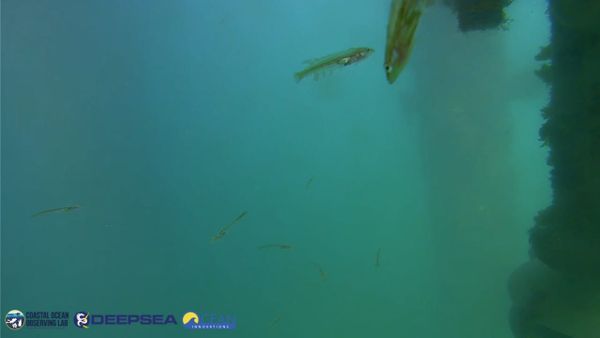
The 4 ft pilings on the right side of the frame are visible with some surface detail, including what appears to be marine growth (kelp/algae) on the structure, though the image is somewhat soft even at this close range. The 11 ft pilings are visible but distinctly hazy, appearing as moderately diffuse shapes without crisp structural detail — consistent with moderate turbidity at this range. The 14 ft pilings are not clearly identifiable as a third distinct tier; I can only confidently locate two piling sets, meaning the 14 ft pilings are absent or indistinguishable from background haze. The water is a characteristic greenish-teal color with significant particulate scatter visible throughout the water column, including numerous small fish or plankton particles suspended mid-water. Overall clarity is moderate-poor with a strong green tint indicating biological turbidity rather than sediment alone.
The greenish-teal water color strongly suggests elevated phytoplankton or chlorophyll content, which scatters light and reduces horizontal visibility without necessarily indicating heavy sediment disturbance. The visible suspended particles throughout the water column point to a biologically turbid water mass rather than swell-driven sediment resuspension. The rising tide may be pulling greener, more turbid water through the pier zone, further degrading conditions from what they may have been earlier in the tidal cycle.
Conditions are marginal at best with roughly 10–13 ft of visibility — acceptable for experienced local divers with modest expectations, but not suitable for photography or low-experience divers. Visibility may improve slightly after high tide passes and the tidal exchange slows, so checking conditions again in the evening or early tomorrow morning before the tide rises again could yield a better window.
• Wind: 5.9 mph
• Cloud Cover: 3%
• Water Temp: 68.0°F
• Chlorophyll: 0.37 mg/m³ (GREEN)
• Swell: 1.0 ft @ 17.0 sec from NW (291°) — favorable
• Tide: Rising → next H at 18:43 (2.955 ft)
• Community Report: No report
Visibility is currently around 8–12 ft, based on the latest Scripps Pier camera image.
The pilings are visible with a slight haze—well-defined in the foreground but softening at distance. Water has a muted blue-green tint. Several fish are schooling around the structure, indicating active marine life.
Conditions are limited by moderate cloud cover (73%) and small residual particles suspended from recent swell. Light winds from the northwest are keeping surface chop minimal. If cloud cover breaks and current stays weak, visibility would likely improve into the 12–15 ft range. For now, today earns a C rating—acceptable conditions for experienced divers, but expect reduced clarity beyond 20 ft depth. Mid-morning through early afternoon offers the best window as the tide rises and brings in clearer water from offshore.
- Wind: 4 mph from NNW
- Swell: 2.1 ft @ 13 sec from SW
- Tide: Rising from low (~0.1 ft)
- Water Temp: 66°F
- Air Temp: 63°F
- Cloud Cover: 73%
- Chlorophyll: Moderate
- Estimated Visibility: 8–12 ft
- Dive Grade: C
- Conditions: Marginal clarity, calm surface
https://coollab.ucsd.edu/pierviz/